
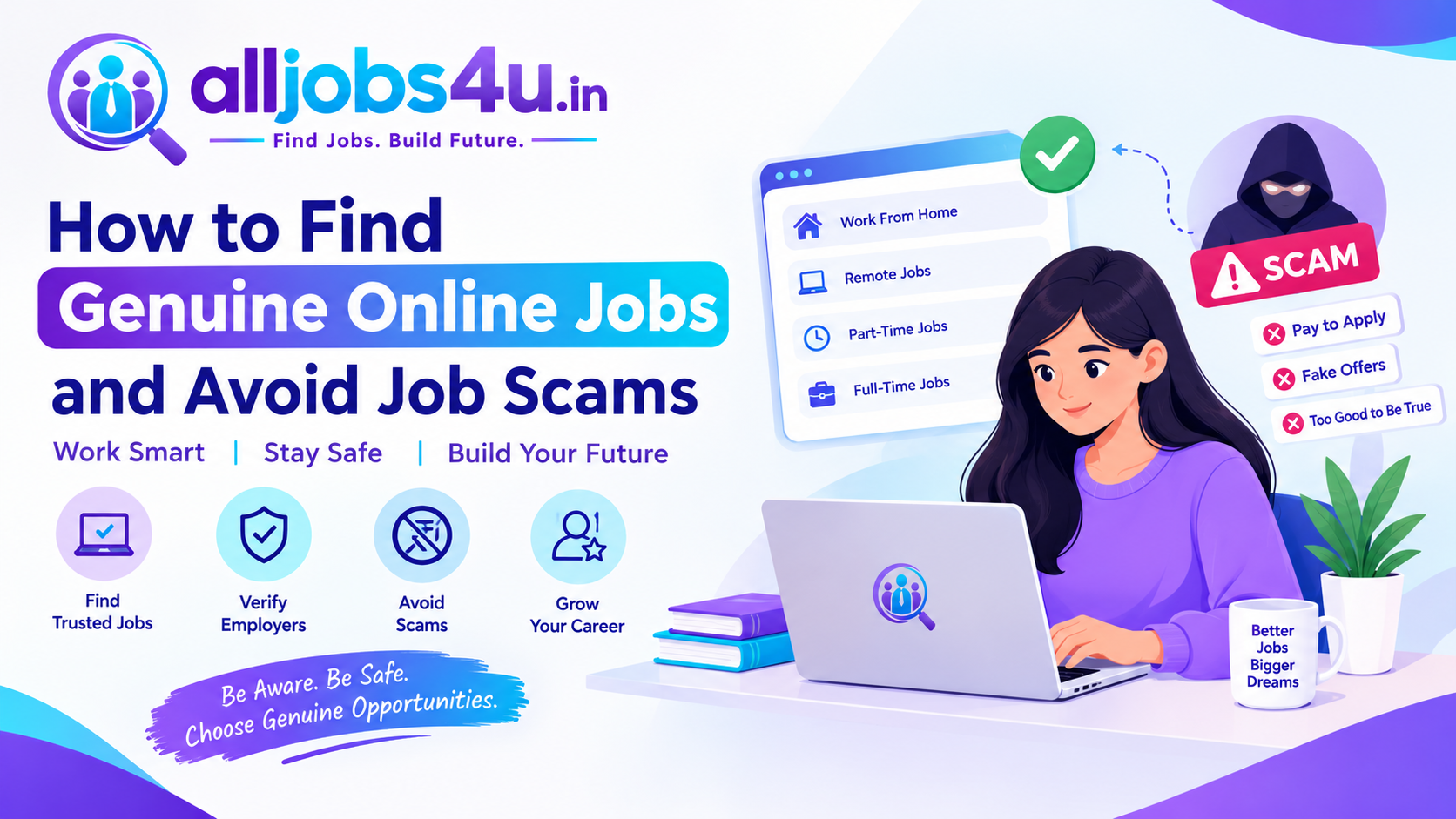
How to Find Genuine Online Jobs and Avoid Job Scams
Finding a job online has become a convenient way to explore career opportunities, work-from-home positions, internships, freelance projects, and full-time employment. However, alongside genuine opportunities, fake job advertisements and online recruitment scams can also target job seekers.
Many fraudsters use attractive job offers, fake company names, and promises of easy income to convince candidates to share personal information or pay money. Freshers and people looking for part-time or remote work can be particularly vulnerable to these misleading offers.
So, how can you identify genuine online jobs and protect yourself from fake recruitment offers?
In this guide, we explain how to verify job opportunities, recognise common warning signs, and apply safely for online jobs in India.
1. Search for Jobs on Reliable Job Portals
Start your job search through established job portals and official company career pages. A reliable job platform can make it easier to discover opportunities across different industries and experience levels.
Before applying, check the job description, company name, location, eligibility criteria, responsibilities, and application process.
You can explore different opportunities through the AllJobs4U job listings, including openings across industries and experience levels.
Remember: A job advertisement appearing on a portal does not automatically guarantee that the employer or vacancy is genuine. Always verify important details independently.
2. Verify the Company Before Applying
One of the most important steps is checking whether the company actually exists.
Follow these simple checks:
Visit the company's official website.
Look for its office address and contact information.
Check whether the job is listed on its official careers page.
Search for the company's professional presence on LinkedIn.
Check whether the recruiter has a verifiable company email address.
Compare the job description with information available from the company.
Example
Suppose you receive a message claiming to offer a work-from-home customer support job at a well-known company.
Before sharing your resume, visit the company's official website and check its careers section. If you cannot find the vacancy, contact the company using the contact details published on its official website.
Do not rely only on the phone number or website link sent by the recruiter.
3. Never Pay Money to Get a Job
A major warning sign of recruitment fraud is a demand for money in exchange for employment.
Be cautious if someone asks you to pay for:
Job registration.
Interview confirmation.
Guaranteed selection.
Offer letter processing.
Security deposits.
Mandatory equipment purchases through an unknown seller.
Verification or joining charges.
The Government of India's National Career Service (NCS) states that its services are free for job seekers and warns against people demanding money while claiming to represent NCS.
You can verify information through the official National Career Service website.
A recruiter asking for payment does not automatically prove fraud in every possible employment-related arrangement, but a payment demanded as a condition of getting a job should be treated as a serious warning sign.
4. Be Careful With Work-From-Home Job Offers
Work-from-home jobs are attractive because they allow people to work remotely. However, scammers sometimes use this interest to advertise unrealistic opportunities.
Be especially careful with offers such as:
Earn a large amount every day by completing simple tasks.
Guaranteed income without an interview or skill assessment.
Data entry jobs requiring an upfront registration fee.
CAPTCHA typing jobs with promised high earnings.
Online tasks that require deposits to unlock withdrawals.
The Indian Cyber Crime Coordination Centre has issued an advisory about fake CAPTCHA-filling job scams. These schemes may demand registration or training payments and later refuse to release the promised earnings.
Practical tip: Before accepting a remote job, ask for a written job description, employer details, payment terms, and official communication channels.
5. Check the Recruiter's Email Address and Contact Details
Scammers sometimes impersonate well-known companies or recruitment agencies.
For example, a fake recruiter may use a free email address while claiming to represent a large organisation.
Check:
Does the email domain match the company's official website?
Does the recruiter's name appear in the company's professional network?
Can the company confirm that the recruiter works there?
Are the phone number and contact details consistent with official company information?
A professional-looking email or company logo is not proof of authenticity. Even genuine-looking websites and documents can be copied.
6. Protect Your Personal and Banking Information
During recruitment, employers may reasonably request information needed to assess your application or complete joining formalities. However, you should share sensitive information only after verifying the employer and understanding why it is required.
Never share these details with an unverified recruiter:
Bank account passwords or ATM PINs.
UPI PINs and OTPs.
Internet banking login details.
Card security information.
Unnecessary identity documents.
Access to your phone or computer through unknown applications.
Do not install an app or open an attachment simply because a recruiter asks you to do so.
A genuine employer does not need your UPI PIN or OTP to process a job application or salary payment.
7. Identify Fake Government Job Websites
Some fraudulent websites imitate government recruitment portals and use official-looking logos, layouts, and department names.
Before applying for a government job:
Visit the official website of the relevant government department.
Check whether the recruitment notification is published there.
Verify the application dates and eligibility requirements.
Read the official recruitment advertisement carefully.
Avoid making payments through links received from unknown WhatsApp numbers or social media accounts.
Government websites commonly use the .gov.in domain, but you should still verify the exact website and recruitment notification through the concerned department.
Delhi Police also advises job seekers to verify suspicious government websites before making payments or sharing personal information.
8. Watch Out for These Common Job Scam Warning Signs
The following signs should make you cautious before accepting an online job offer.
| Warning sign | Why you should be careful |
|---|---|
| Guaranteed selection without assessment | May be an attempt to attract applicants through false promises |
| Upfront registration payment | Could be a recruitment payment scam |
| Very high earnings for simple tasks | May be an unrealistic income promise |
| No verifiable company details | Employer identity may be false |
| Pressure to pay immediately | Creates urgency and prevents proper verification |
| Requests for OTP or UPI PIN | Can expose your financial accounts |
| Unofficial offer letters | Documents may be copied or fabricated |
One warning sign alone may not establish that an offer is fraudulent. However, multiple warning signs should prompt you to stop and verify the opportunity.
9. How to Apply for Online Jobs Safely
Follow this simple process whenever you find an online job opportunity:
Step 1: Read the job description
Understand the role, required qualifications, experience, responsibilities, and work arrangements.
Step 2: Verify the employer
Check the company's official website and contact information.
Step 3: Check the recruiter
Confirm that the person contacting you is associated with the organisation.
Step 4: Prepare your resume
Share a professional resume containing relevant education, skills, and work experience. Avoid including unnecessary sensitive information.
Step 5: Apply through an official channel
Whenever possible, use the company's official careers page or a trusted job portal.
Step 6: Review the offer before joining
Read the employment terms, responsibilities, salary structure, working hours, and other conditions carefully.
10. What to Do If You Have Been Scammed?
If you have already paid money or shared financial information with someone claiming to be a recruiter, act quickly.
Contact your bank or payment service provider immediately if money has been transferred.
Report financial cyber fraud by calling 1930 as soon as possible.
Submit a complaint through the official National Cyber Crime Reporting Portal.
Preserve payment receipts, transaction IDs, phone numbers, emails, messages, and screenshots.
Change compromised passwords and secure your accounts.
Do not pay additional money to someone promising to recover your lost amount.
Quick reporting may help authorities and financial institutions respond to the incident. It does not guarantee recovery of the money.
11. Where Can You Find Genuine Online Job Opportunities?
You can explore online job opportunities through different channels:
Job portals: Search for vacancies based on skills, experience, location, and industry.
Company career pages: Apply directly through an employer's official website.
Government employment services: Explore opportunities through the National Career Service.
Professional networks: Connect with recruiters and follow verified company pages.
Freelance platforms: Look for project-based work and carefully review client profiles and payment arrangements.
You can also explore current vacancies on AllJobs4U and discover opportunities across different sectors.
Whether you are a fresher, an experienced professional, or looking for remote work, take time to check each opportunity before applying.
Frequently Asked Questions (FAQs)
1. How can I find genuine online jobs in India?
Search through established job portals, official company career pages, and government employment services. Verify the employer, recruiter, job description, and application process before sharing information.
2. Are work-from-home jobs genuine?
Yes, many companies offer genuine remote and work-from-home positions. However, candidates should check the employer's identity, responsibilities, payment terms, and recruitment process before accepting an offer.
3. Do genuine companies ask for registration fees?
Be cautious of employers demanding money as a condition of selection or joining. The National Career Service does not charge job seekers for registration, applications, or interview processing.
4. How can freshers avoid online job scams?
Freshers should verify company details, avoid upfront payments, check recruiter email addresses, and never share OTPs, UPI PINs, or banking passwords.
5. What should I do if I receive a fake job offer?
Do not make payments or share additional information. Save the messages and payment details, contact your bank if necessary, and report suspected cyber fraud through 1930 or the official cybercrime portal.
6. Can I find genuine jobs through AllJobs4U?
AllJobs4U provides job information to help candidates explore opportunities. Candidates should independently verify employers and job details before applying. The portal does not guarantee recruitment or selection.
Conclusion
Finding genuine online jobs requires more than simply searching and applying. You should verify employers, carefully read job descriptions, protect your personal information, and avoid suspicious payment requests.
Whether you are looking for your first job, a remote position, or a new career opportunity, a careful approach can help you make safer decisions.
Explore the latest job opportunities on AllJobs4U, prepare your resume, and take the next step towards your career. Stay informed, stay alert, and never pay money in exchange for a job guarantee.